How Does AEO Differ From Traditional SEO? (And Why You Need Both)
How Does AEO Differ From Traditional SEO? (And Why You Need Both)
TLDR: AEO isn't "SEO 2.0." It's a layer you build on top of SEO fundamentals. After working with 100+ agencies, here's what matters: your SEO foundation determines whether AEO tactics work. Sites with strong SEO see 15-40% visibility lifts from AEO optimization. Sites with weak SEO see nothing. The difference: AEO optimizes for AI citations (not rankings), needs literal content (not keywords), and requires multi-platform presence. But you still need technical SEO, quality content, and good rankings. You can't do AEO without SEO. You need both
The Question Everyone's Getting Wrong
The same questions comes up in nearly every one of our conversations: how does AEO differ from traditional SEO?
We answer it the same everytime: AEO and SEO aren't the same thing. But you need SEO to do AEO.
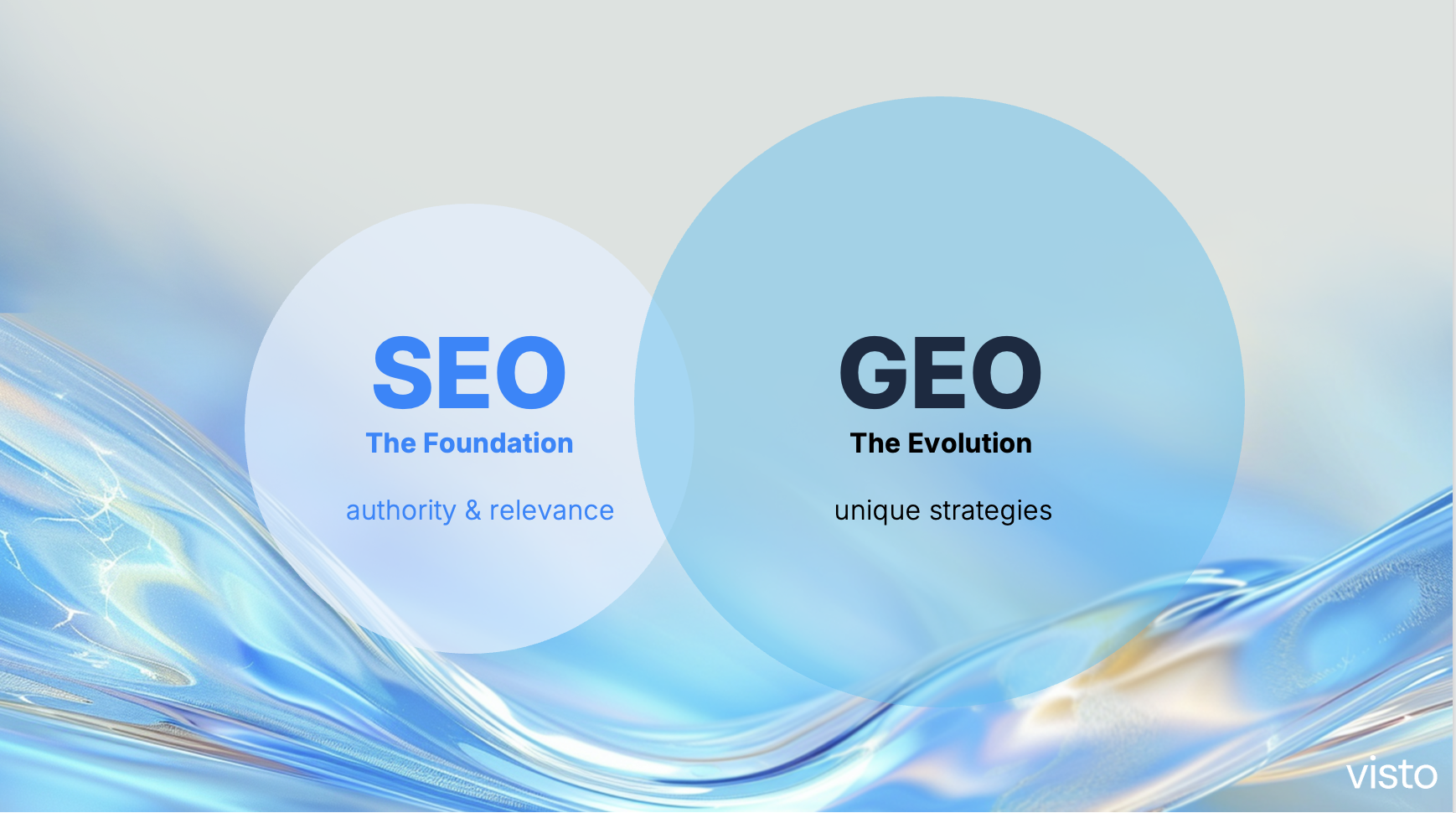
Think of it like a Venn diagram. There's overlap. There are differences. But one doesn't replace the other.
We’re seeing agencies struggle because they're treating this as an either/or decision. Some are saying "GEO is completely different, forget everything you know about SEO." Others are claiming "it's just SEO, nothing has changed."
Both are wrong.
The data is clear: your SEO fundamentals determine whether AEO tactics work at all.
Sites with strong SEO foundations could see 15-40% visibility lifts from AEO optimization. Sites with weak SEO see almost no movement.
So let's break down what makes AEO different from traditional SEO, and why treating them as separate strategies is setting you up to fail.
If you’ve got this far and you don’t know what AEO or GEO is, read this blog.

The Foundation: Why SEO Still Matters
Before we get into differences, let's talk about what hasn't changed.
Content quality still matters AI models cite content from the top search results. If your content doesn't rank in the top 300 results, AI platforms won't even see it.
There's a reason stuff ranking in the top 10 shows up in AI citations more often. You still need to rank well for AI to consider your content.
Technical SEO is still crucial Schema markup, JSON-LD, crawlability - all the technical stuff you've been doing for SEO? Still necessary for AEO.
AI crawlers need to access and understand your content just like traditional search engines do.
Site health matters Slow sites, broken links, poor mobile experience - these don't just hurt your SEO. They hurt your AI visibility too.
When we audit agencies' client sites, we see this pattern: sites with technical SEO issues struggle to get AI citations no matter how much they optimize content for AI.
Here's the key insight: AEO tactics are built on top of SEO fundamentals. You're not replacing one with the other. You're adding a new layer.
We tell agencies: keep doing your SEO hygiene. Schema, structured data, good headings, quality content - all that still applies.
The agencies successfully upselling AEO right now to their clients? They're the ones who had strong SEO practices to begin with.
Still wondering how AEO can impact your business? Read HERE.
The 5 Ways AEO Differs From Traditional SEO
Now let's get into what's different. Because there ARE differences, and understanding them is how you win.
Difference #1: Rankings vs. Citations
SEO: You optimize to rank #1 for a specific keyword
AEO: You optimize to be one of 5-10 sources the AI cites
When someone searches "best project management software" on Google, one result wins position #1.
When someone asks ChatGPT the same question, ChatGPT runs multiple search queries, pulls results from dozens of websites, and picks 5-10 to cite in its answer.
Position matters less than being in the consideration set.
We're seeing tiny companies show up in ChatGPT responses ahead of massive brands. Not because they rank higher in traditional search, but because their content is structured for AI consumption.
The ranking gets you considered. The content structure gets you cited.
Difference #2: Keyword Matching vs. Literal Content
SEO: You optimize for keyword variations and semantic relationships
AEO: AI needs brutally literal content
Here's what I mean: traditional SEO taught us to include keyword variations. "Project management tools," "PM software," "team collaboration platforms" - all variations of the same concept.
AI models parse this differently. They have a content window. When you stuff keywords, relevant information gets pushed outside that window and ignored.
AI is literal. If someone asks "what's the best CRM for real estate," and your content says "top sales tools for property professionals," AI might not make the connection.
Write direct answers to specific questions. Use the exact language your customers use.
At Brighton SEO, one of the big takeaways was: stop trying to be clever with synonyms. Answer the question directly.

Difference #3: Systematic Crawling vs. Impatient AI
SEO: Google's crawlers systematically index your entire site
AEO: AI crawlers are extremely impatient
Traditional search engine crawlers are patient. They'll eventually index your whole site. They'll find content buried three clicks deep.
AI crawlers during a search? They need to find answers immediately.
If your key information is buried halfway down a 3,000-word article, AI bounces. You become invisible to AI search.
Front-load your most important information. Structure content so AI can extract value in seconds.
I've seen this kill AI visibility for agencies with great content. The information was there. It was just too hard to find quickly.
Difference #4: Domain Authority vs. Content Clarity
SEO: Domain authority heavily influences rankings
AEO: Content structure matters more than domain authority
This one surprises people.
In traditional SEO, a page on a high-authority domain has an advantage. Backlinks, domain age, brand signals - these all factor into rankings.
For AI citations? Content structure and clarity matter more.
We're tracking visibility across ChatGPT and Perplexity for 700+ companies. Fortune 500 companies with terrible content structure lose to startups with clear, well-structured content.
AI doesn't care about your domain authority if your information is hard to parse.
This is why small companies are winning. They're structuring content for AI consumption while big companies are still optimizing for traditional search signals.
Domain authority still helps - it gets you into the search results AI considers. But content structure determines whether you get cited.
Difference #5: Link Building vs. Multi-Platform Citations
SEO: Backlinks signal authority
AEO: AI prioritizes citations across multiple platforms
Traditional SEO taught us: build backlinks to show authority.
AEO works differently. AI models pull from Reddit, Quora, Wikipedia, news sites, and authoritative sources across the web.
Your content needs to exist in multiple places, structured for different platforms.
Reddit-style question-and-answer formats. Quora discussions. Wikipedia-style explanations. Community-driven language.
AI heavily weights content from these platforms. It's not just about having one perfect page on your site. It's about having your information available in formats AI prefers.
The agencies getting the best results? They're distributing content across platforms, not just optimizing their own site.
Why the "SEO 2.0" Label Is Misleading
We keep seeing people call GEO "SEO 2.0."
This drives us crazy because it's not an upgrade. It's an addition.
SEO 2.0 implies version 2 replaces version 1. That's not what's happening here.
Traditional SEO still drives the majority of organic traffic. Google still sends more traffic than AI search platforms (for now).
The agencies treating AEO as a replacement for SEO are making a mistake. The agencies ignoring AEO and just doing traditional SEO are also making a mistake.
Here's the right way to think about it:
SEO gets you in the game. AEO helps you win once you're playing.
Your SEO fundamentals determine whether AI platforms even see your content. Your AEO optimization determines whether they cite it.
Skip the SEO foundation, and your AEO tactics fail. Skip the AEO layer, and you're invisible in AI search while your competitors show up.
Both matter. You need both.
How to Implement Both (Practical Framework)
So how do you do both without doubling your workload?
Here's the framework we're using with our agency partners:
Step 1: Audit Your SEO Foundation
Before touching AEO tactics, make sure your SEO is solid:
- Technical SEO health check (crawlability, site speed, mobile experience)
- Content rankings for target keywords
- Schema markup implementation
- Internal linking structure
If you're failing here, fix this first. AEO tactics won't save you.
Step 2: Layer AEO Optimization on Top
Once your SEO foundation is solid, add AEO tactics:
- Restructure existing content with front-loaded information
- Rewrite for literal, direct answers
- Add question-and-answer formats
- Implement consistent brand phrases
You're not replacing content. You're restructuring it to work for both traditional search and AI.

Step 3: Expand to Multi-Platform
Distribute content across platforms AI prefers:
- Answer questions on Reddit related to your expertise
- Contribute to Quora discussions
- Create content in community-driven formats
- Build citations beyond your own domain
Step 4: Measure Both
Track traditional SEO metrics AND AI visibility:
- Keyword rankings (traditional SEO)
- AI citation frequency (AEO)
- Traffic from both sources
- Conversion differences
We built Visto specifically to help agencies measure both. Because you can't optimize what you don't measure.
Here’s what Visto 2.0 can do.
FAQ SECTION
Q1: Do I need to hire separate teams for SEO and AEO? No. Your existing SEO team should learn AEO tactics. These strategies overlap significantly, and separating them creates inefficiencies. The skills transfer: understanding how search engines work helps you understand how AI processes content. Add AEO training to your team rather than building separate departments. With a tool like Visto, it makes everything much easier.
Q2: How much of my SEO knowledge transfers to AEO? About 60-70%. Content quality, technical SEO, site architecture, and structured data all apply to both. What's new: content structuring for AI consumption, front-loading information, literal writing style, and multi-platform distribution. Your SEO foundation makes learning AEO easier.
Q3: Should I rewrite all my content for AEO? No. Start with your highest-performing SEO content. Pages already ranking well are more likely to get AI citations. Restructure those first with front-loaded information and direct answers. Then move to other high-value pages. Don't rebuild your entire site at once.
Q4: How long does it take to see AEO results? Faster than traditional SEO in some cases. We're seeing visibility changes in AI platforms within 2-4 weeks of optimization. Traditional SEO changes can take months. But sustainable success requires both short-term AEO wins and long-term SEO foundation.
Q5: Can I just do AEO and skip traditional SEO? No. AI platforms pull from traditional search results. If you're not ranking well in traditional search, AI won't see your content to cite it. AEO without SEO is like building a second floor without a foundation. It doesn't work.
Q6: What happens if I ignore AEO and just focus on SEO? You're leaving visibility on the table. 60% of searches now end without a click as AI provides direct answers. Your competitors optimizing for AI search will appear while you don't. AEO is insurance for the future as AI search grows.
Q7: How do I convince clients to invest in both? Frame it as protecting existing traffic while capturing new opportunities. Show them their current AI visibility (most are shocked they're invisible). Demonstrate competitor presence in AI search. The agencies having success position AEO as essential for client retention, not just growth.
Q8: What if my content ranks #1 but doesn't get AI citations? This happens frequently. Ranking gets you considered, but content structure determines citations. Audit your content for: front-loaded information, direct answers, literal language, and scannable formatting. Your ranking is good. Your structure needs work.
Q9: Do industry-specific sites need different AEO approaches? The fundamentals stay the same. B2B, healthcare, SaaS, e-commerce - all need strong SEO foundations and AI-optimized content. What changes: the questions your audience asks, the platforms they use, and the content formats they prefer. Adapt tactics to your industry, but the framework applies universally.
Q10: How do I measure success for both SEO and AEO? Track separately but report together. SEO metrics: keyword rankings, organic traffic, backlink profile. AEO metrics: AI citation frequency, visibility scores across platforms, traffic from AI sources. Success means improving both over time. One shouldn't cannibalize the other.
CONCLUSION
Here's what you need to remember:
AEO differs from SEO in how content gets selected (citations vs. rankings), how it needs to be written (literal vs. keyword-focused), and how AI processes it (impatient vs. systematic).
But AEO doesn't replace SEO. It builds on top of it.
Your SEO fundamentals - technical health, content quality, site structure - determine whether AEO tactics work at all.
The agencies winning right now? They're not choosing between strategies. They're doing both.
Strong SEO foundation. Layered AEO optimization. Multi-platform distribution. Consistent measurement.
That's the framework.
If you're an agency and you need help measuring your clients' AI visibility or building a strategy that works for both traditional search and AI platforms, my team built Visto specifically for this.
Book a demo and we'll show you where your clients appear (or don't appear) in ChatGPT, Perplexity, and Google AI Overviews.
Because you can't optimize what you don't measure.




.avif)