Where AI Gets Its Answers: How to Read Citation Data and Get Your Brand Cited
TL;DR
- Most brands track whether they appear in AI answers. Far fewer track where the model went to build the answer in the first place. Citation data closes the gap between a score and a to-do list.
- A visibility score reports the outcome. Citation data reports the mechanism, which is the part you influence.
- Every AI answer draws on a set of sources before a single word gets written. Review sites, trade journals, forums, competitor pages.
- Reading the source map for your industry tells you where to earn placement, and where to stop spending.
- Citation durability rests on traditional search standing. When a source slips in Google, your citation inside it slips too. This is the part most GEO advice leaves out.
- Reddit and Quora carry weight in some sectors and none in others. Run the map for your category rather than assuming.
The number that tells you nothing
Most brands we talk to track one thing in AI search. Do we show up?
Useful, and incomplete.
A visibility score tells you the result. The result on its own gives you nothing to do on Monday morning.
The data you're missing sits one layer down. Where the model went to build the answer in the first place.
Every time someone asks ChatGPT or Perplexity a question about your industry, the model pulls from a set of sources before it writes a word. Review sites. Trade publications. Forums. Competitor pages. Those sources shape the answer far more than anything sitting on your own website.
Read the sources and you get a work plan. Read the score alone and you get a slide.
What is citation analysis?
Citation analysis is the practice of capturing every source URL an AI model uses when answering the prompts in your category, then ranking those sources by frequency. The output is a map of the sites feeding the model, and a ranked list of where to earn placement next.
One audit produces the map. Repeated audits produce the trend line, which is where the strategy lives.
Why does citation data beat a visibility score?
Because a visibility score answers one question, and citation data answers the next five.
Say you sit at 8% visibility across your category. Worth knowing. Now what?
Nothing in the number tells you which pages to build, which publications to pitch, or which review platform to point customers toward. You know you're behind. You still have no route forward.
Citation data names the route. For each prompt, you see the URLs the model leaned on to construct its answer. Do this across a full prompt library and patterns surface fast:
- The sources feeding your category, ranked by how often models return to them
- The competitors appearing in answers, and the specific pages earning them the mention
- The gaps where no strong source exists yet, which is where new content wins quickest
Score plus sources gives you a report and a plan. Score alone gives you a report.
.png)
How does AI build an answer?
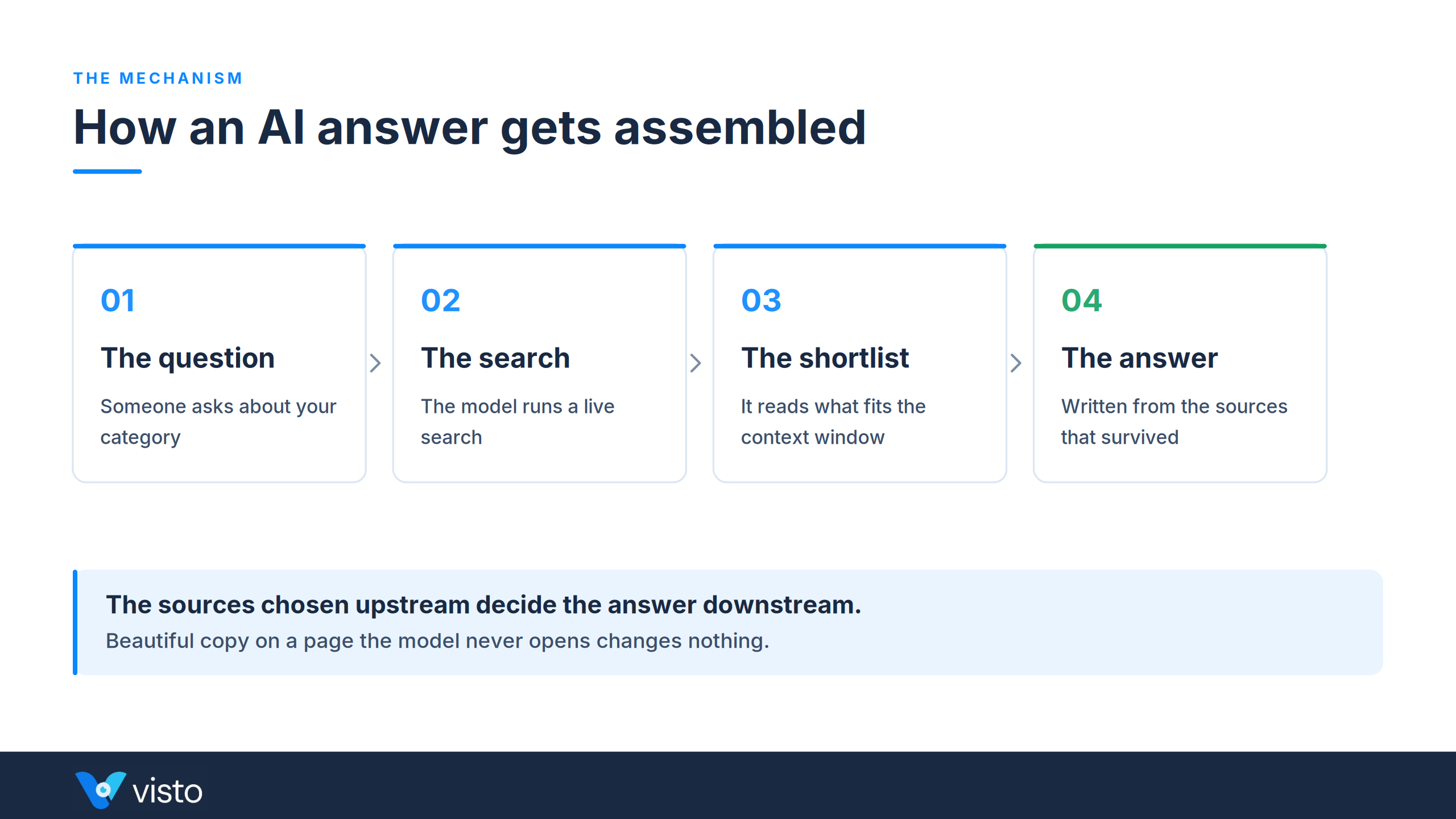
An AI answer gets assembled at the moment you ask for it. The model runs a search, pulls a shortlist of sources, reads what fits inside its context window, and writes from what survives.
Two consequences follow.
First, the sources chosen upstream decide the answer downstream. Beautiful copy on a page the model never opens changes nothing.
Second, the shortlist is small. Models pull a handful of sources per answer, not fifty. Being source number twelve in a category has the same effect as being invisible.
So the work splits in two. Get your own pages onto the shortlist. And get your brand represented inside the sources already on the shortlist. Most teams attempt the first and skip the second, which is where the faster wins usually sit.
Why your Google standing decides how long a citation lasts
This is the part most GEO advice leaves out, and it changes how you read everything that follows.
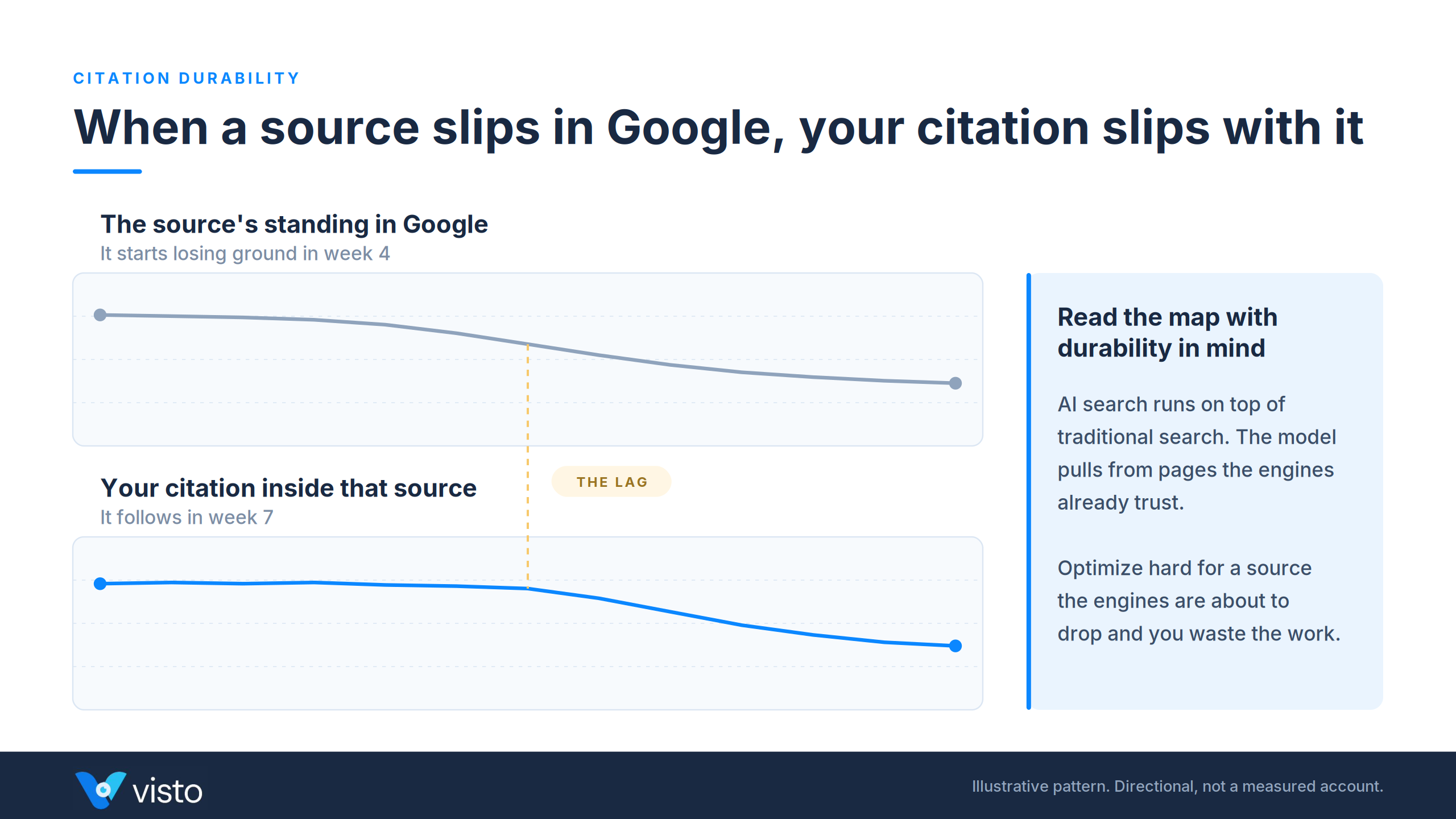
AI search runs on top of traditional search. When a model builds an answer, it pulls from pages the search engines already trust. The same content ranking in Google feeds the answer in ChatGPT.
So movement in one shows up in the other. When a search engine de-prioritizes a type of page, the models follow within weeks. A listicle losing ground in Google starts losing ground in AI answers. An SEO movement driving a GEO outcome.
Read your source map with that in mind. A site feeding the model today rests on its standing in traditional search. If the standing slips, your citation inside it slips with it. Optimize hard for a source the search engines are about to drop and you waste the work.
Citation strategy tracks both signals at once. Where the model pulls from now, and where the search engines are pushing those sources next.
What does citation analysis show you about your category?
Two findings come out of every run. Who the model recommends in a fair fight, and where the model goes for information.
Both need a prompt library underneath them. We build 150 to 200 prompts per account, spanning informational questions, non-branded discovery and branded queries. Every link returned across every prompt gets captured, which turns one-off tests into a dataset you compare over time.
The fair race: who does AI recommend when the field is even?
Strip the brand names out of the prompt and you get an honest read on standing.
Non-branded discovery prompts ("best [category] for [use case]") put every player in the category on the same start line. Nobody gets an advantage from having their name in the question. Whoever the model names is whoever the model trusts.
Run those prompts at volume and the ranking stops being opinion. Say you appear in 11 of 150 answers and one competitor appears in 68. Painful, clear, and impossible to argue with.
Relative share also survives contact with a skeptical CEO far better than an absolute score. Share of voice is the number that gets repeated back to you in the next board update.
The source map: where does AI go for information?
The second finding sits in the links themselves.
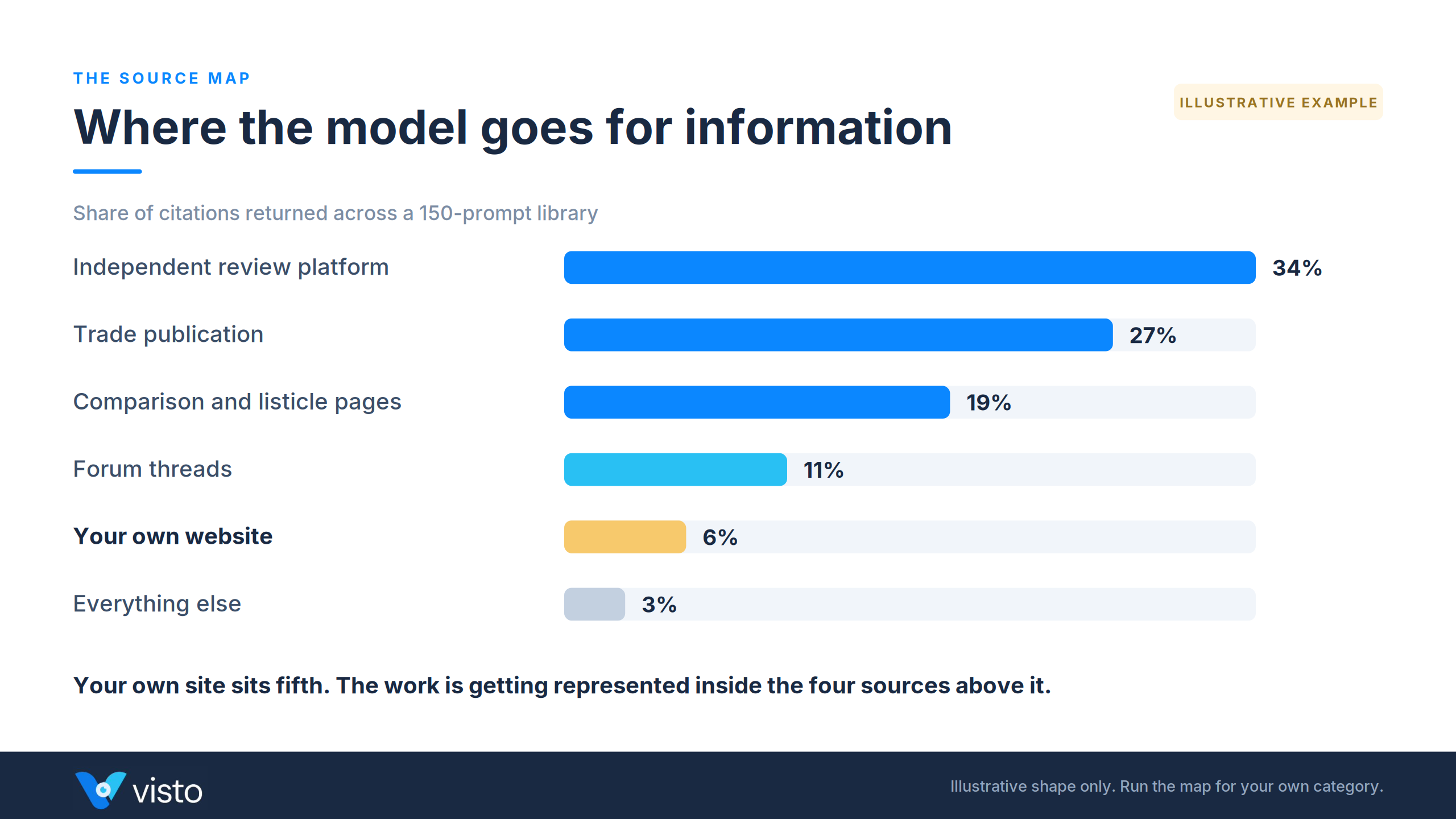
Capture every URL across the full prompt set and rank them by frequency. What comes back is a map of the sources feeding your category. Usually a small number of sites do most of the work, and the mix rarely matches what you expect going in.
You read the map, and you know where to act. In the exact places feeding the model right now.
How do you turn citation data into an action plan?
Match the finding to the fix. The map pays off when you act on it, and the most common findings each come with an obvious move.
When AI pulls from a review site
Say the source map shows the model leaning on one specific review platform. A smaller site doing the heavy lifting in AI answers rather than the big name you assumed carried the weight.
The action writes itself. Point your happy customers to leave reviews on the site the model trusts. More strong reviews feed the model. You show up stronger in AI recommendations over the following weeks.
No new tooling. One redirected request, aimed at the source the data named.
When AI pulls from a trade journal over the national press
Say the model keeps citing a trade journal ahead of the major outlet you've spent years trying to land.
Good news hides in this finding. The trade journal is far easier to get into. Some of these publications accept sponsored pieces outright. Search Engine Land and Search Engine Journal, for example, show up often in our space, and you pay to feature in them.
So you redirect the PR effort. Stop burning months on the national outlet the model barely reads. Get into the trade journal the model cites every day. New coverage, new sources feeding the answer.
When Reddit and Quora show up, and when they do not
Forums are the wild card. For some industries they carry real weight in AI answers. For others they barely register.
The point is you find out for your own category rather than assuming. Run the source map. If forums feed the model in your space, a Reddit and Quora strategy earns its place in the plan. If they do not, you skip the effort and spend the budget where the data points.
Guessing here wastes months. The map removes the guess. Our guide to how Reddit and Quora feed AI citations covers the mechanics.
What does movement look like?
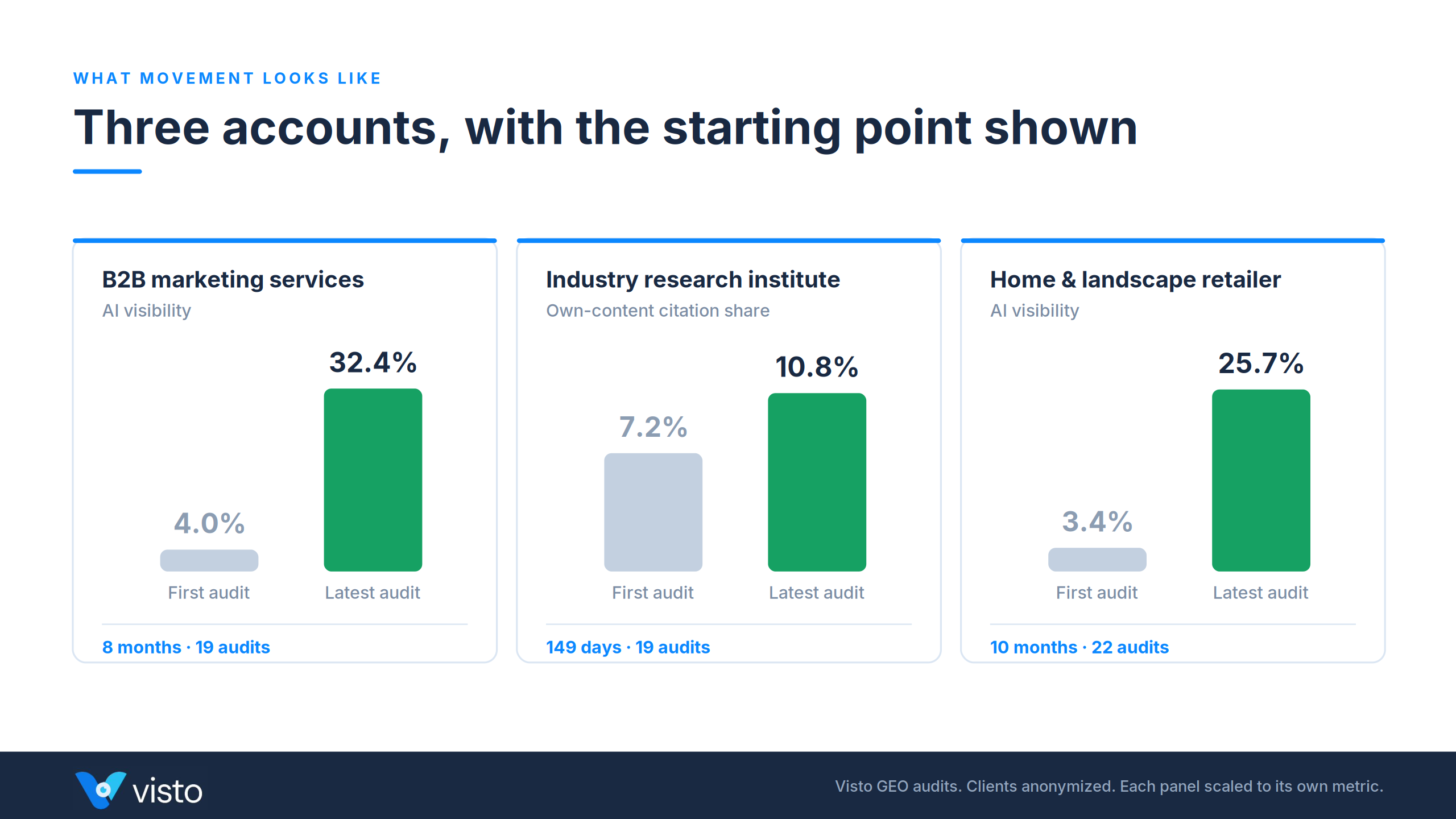
Three anonymized accounts working this way, with the starting point shown alongside the result.
A B2B marketing services firm. AI visibility moved from 4.0% to 32.4% of tracked buyer prompts over eight months and 19 audit cycles. Share of voice went from 14.6% to 47.4%, which is close to half of every brand mention in its competitive set. Top-3 Google keyword count climbed 28% over the same period, from 46 to 59 in Ahrefs.
An industry research institute. The one to read closely if citations are your metric. Own-content citation share moved from 7.2% to 10.8% across 19 audits over 149 days. AI visibility went from 14.8% to 18.3%. Top-3 Google keywords rose 40%, from 25 to 35. The institute went from watching news aggregators get credited for its own research to being the source the models point at.
A regional home and landscape retailer. AI visibility from 3.4% to 25.7% over ten months and 22 audits. Share of voice from 0% to 61.7%, so from unmentioned to the majority voice in its category answers.
All three followed the same sequence. Baseline audit, source map, work aimed at the sources the map named, re-audit, repeat. The gains arrived steadily across every cycle rather than in one spike.
How often should you re-run citation analysis?
Weekly for active accounts. Monthly at the absolute minimum. AI answers move, and three things shift underneath you.
What changesHow fastWhat it does to your dataModel updates and retrainingUnpredictable, often weeklySources drop in and out of favor with no warningNew content entering the indexDaysA competitor publishes and appears in answers within the weekSearch rankings behind the sourcesWeeksA cited source loses ranking, then loses the citation
A single audit is a photograph. The value sits in the trend line, which needs the same prompt library run on the same schedule.
FAQ
Where does ChatGPT get its information?From two places. Training data, which is fixed until the next model update, and live retrieval, where the model runs a search and reads a shortlist of pages before answering. Citation analysis shows you the second layer, which is the one you influence week to week.
What sources does AI cite most often?It varies by industry, which is the entire point of running a source map. Common patterns include review platforms, trade publications, comparison and listicle pages, and forums. You only learn the mix for your category by running your own prompts.
Do Reddit and Quora help with AI citations?In some categories, strongly. In others, barely at all. Run the source map before committing budget to a forum strategy.
How is citation analysis different from tracking AI visibility?Visibility tracking answers whether you appeared. Citation analysis answers where the model went to build the answer. One is measurement, the other is direction. Use both.
How many prompts do you need for reliable citation data?We build 150 to 200 prompts per account. Starting manually, 25 to 50 gives you a usable signal, weighted toward non-branded discovery prompts.
How quickly does new coverage show up in AI answers?Days to weeks once the source is indexed, faster on high-authority sources the models already return to often.
Does improving AI citations help my Google rankings?The same structured content works on both surfaces. In the research institute account above, citation share grew 50% while top-3 Google rankings grew 40% off the same work.
What to do next
A visibility score tells you where you stand. Citation data tells your team what to do on Monday.
Where to start:
- Build the prompt library, weighted toward non-branded discovery
- Capture every source URL across the full run and rank by frequency
- Aim the next quarter of content and PR work at the top sources on the list, filtered for which ones hold their Google standing
For the tracking side, read our companion guide on how to measure GEO campaign success.
See the source map for your category. Book a session with the Visto team




.avif)