How a B2B SaaS Company Went From 3% to 12% AI Search Visibility in 60 Days

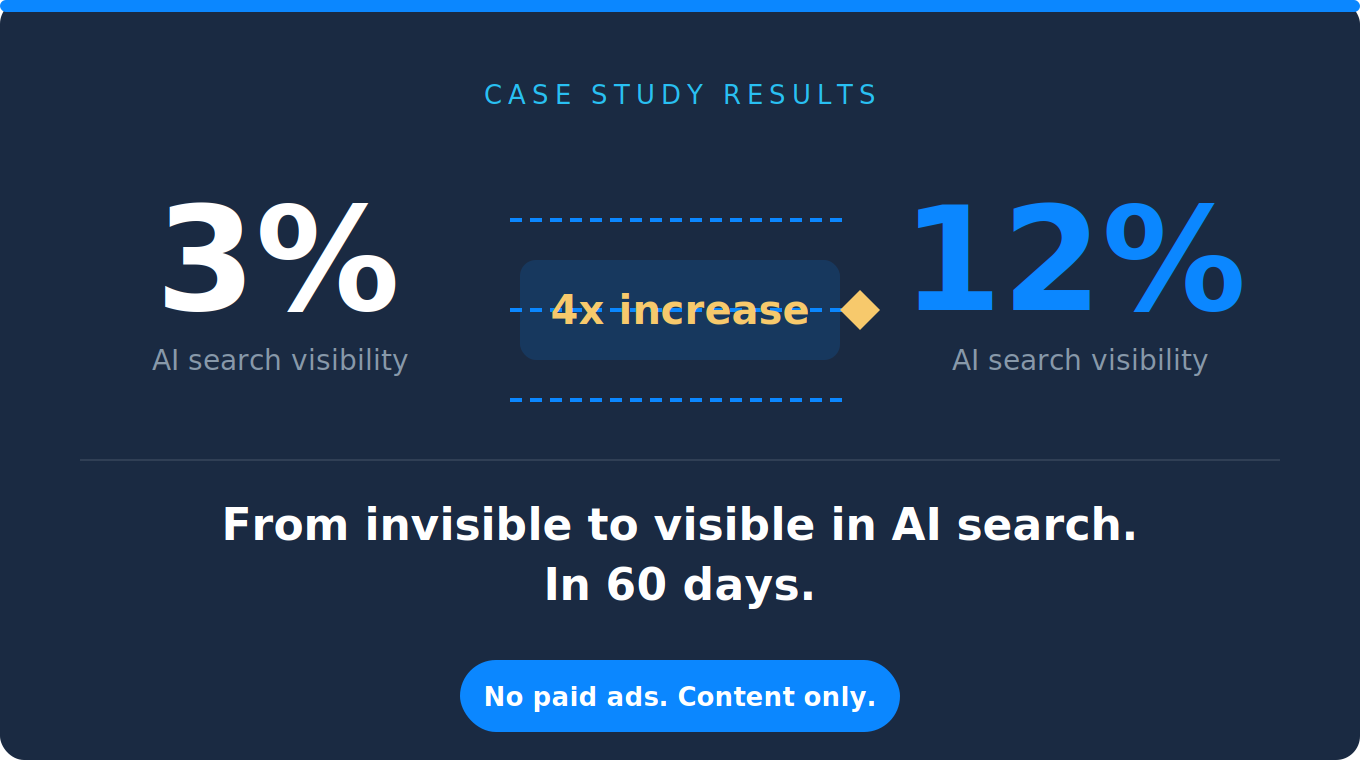
TL;DR: A B2B wholesale SaaS company had zero visibility across ChatGPT, Perplexity, and Google AI Overviews. Their biggest competitor owned the AI search results for every relevant query. Within 60 days of implementing a structured GEO strategy, they went from under 3% AI search visibility to over 12%. The approach: identify the prompts people were typing into LLMs, build pillar pages answering those prompts directly, and add Q&A schema across all content. Two pillar pages per week. Two blog posts per week. No paid promotion. This is a playbook every agency should be running for their clients right now.
The Board Meeting Question Nobody Could Answer
Tim McLain has been doing marketing for over two decades. He's built SEO programs from scratch, managed conversion rate optimization across hundreds of pages, and run digital strategy for multiple SaaS companies.
At his previous company, he'd added over 200 individual web pages to the site to improve Google visibility and conversion rates. The SEO playbook was working, rankings were strong and traffic was steady.
Then an investor asked a question during a board meeting that stopped him cold:
"What are you doing about your visibility on ChatGPT and Perplexity?"
Tim didn't have an answer. Not because he wasn't paying attention but because there was no process, no tool, and no framework to address it. AI search was too new and the entire category of Generative Engine Optimization didn't exist yet.
He did what most marketers do when they don't have a solution. He assigned a team member to search ChatGPT and Perplexity by hand and document what came up. They'd type in industry queries manually and screenshot the results.
The findings were brutal.
Their company was invisible across every LLM. Their biggest competitors were showing up across the board and there was no systematic way to fix it.
This is the exact moment happening in boardrooms and client meetings right now. Executives are asking questions about AI search visibility, and most marketing teams don't have answers.
A New Role, the Same Old Problem
When Tim moved into his current position as Director of Marketing at a B2B wholesale SaaS platform, the conversation came up in his first executive meeting.
The company provides a software platform for wholesale brands. Think big names in apparel, outdoor gear, and golf equipment that need to connect with their retailers and sales reps for ordering, inventory management, and product delivery. They compete with Shopify, ElasticSuite, and NuOrder in a niche but high-value market.
The exec team wanted two things: AI features added to the product and a strategy for AI search visibility. Tim had the scars from his previous role. He knew the problem was real and he also knew he needed data to take action.
Within the first few weeks, he ran a competitive analysis across AI search platforms. What he found confirmed his fears.
Shopify owned a majority of the AI search results for B2B wholesale queries. They were showing up across ChatGPT, Perplexity, and Google AI Overviews for nearly every relevant prompt.
NuOrder, one of their other competitors, was almost completely invisible.
Tim's company was sitting right there with NuOrder. Under 3% visibility across all AI search queries related to their products and services.
Three percent. After years of SEO investment. After 200+ web pages. After all the A/B testing, CRO work, and content marketing. None of it translated to AI search presence.
Why Traditional SEO Didn't Transfer to AI Search
This is one of the biggest misconceptions agencies need to address with their clients: strong Google rankings don't automatically mean strong AI search visibility.
Here's why.
When someone searches Google, they type short keyword phrases. "B2B wholesale platform." "Best wholesale software." Marketers have spent years optimizing for these.
When someone uses ChatGPT or Perplexity, they type full sentences and questions. "What's the best B2B wholesale platform for a brand that needs to connect its retailers and sales reps with real-time inventory?" The prompt space is wider, more diverse, and more conversational.
The LLMs don't look at your site the way Google does. They scrape content, process it through their models, and decide whether to cite you. If your content is buried behind JavaScript, loaded with images instead of text, or doesn't directly answer the questions people are asking, you become invisible.
Tim described it this way: B2B marketing changed more in the past year than in the previous five. His team now spends more time thinking about LLM visibility than they do about Google.
That's a shift every agency needs to hear and internalize. Your clients' organic traffic is declining 15-30% because of AI search. If you're not offering GEO services, someone else will.
The Strategy: Prompt Discovery, Pillar Pages, and FAQ Schema
Once Tim had visibility into the specific prompts people were using across LLMs, the strategy became straightforward. Not easy. But clear.
Step 1: Identify the prompts that matter.
The first move was understanding what people were typing into ChatGPT and Perplexity about B2B wholesale. Not keywords. Full prompts.
Things like: "What does B2B mean for business?" and "What is B2B wholesale?" and "What is the best wholesale platform for apparel brands?"
Tim's reaction when he first saw the prompt data: "I would never have written this sentence unless this type of thing was surfaced up."
That's a critical insight. The prompts people use in AI search are different from the keywords marketers have been optimizing for. You need prompt-level data to create content that LLMs will pick up.
Step 2: Build pillar pages that answer those prompts directly.
Tim's team created a pillar page template in HubSpot. Each page had a table of contents structured around the specific questions being asked in AI search, with content flowing down from there. Related content linked out to deeper pages on the site.
The content was structured to be what Tim called "100% LLM food." Direct questions. Clear answers. Organized in a way AI crawlers process and extract quickly.
Two new pillar pages were published every week. The cadence was aggressive but necessary.
Step 3: Add Q&A schema to every piece of content.
Every blog post now included Q&A-style content at the bottom, formatted with structured schema markup. Tim's team experimented with different formats: dropdown FAQ sections, inline question-and-answer pairs, and dedicated Q&A blocks.
They found the format mattered less than the structure. The key was having the question explicitly stated and the answer immediately following it. Question, then answer. No preamble.
Step 4: Front-load critical content in the top 25% of the page.
After running content audits, the team discovered some of their Q&A content was buried too deep on the page. AI crawlers are impatient. If they don't find relevant information near the top, they move on.
The team restructured pages to push the most important content higher. Key questions and answers moved above the fold or into the first quarter of the page. This single change improved how LLMs processed their content.
Step 5: Maintain a relentless publishing schedule.
Two pillar pages per week. Two blog posts per week. Every piece of content was built around prompt data, not guesswork. Tim told his content team: "Every blog has to be optimized around the data we get from our AI visibility tools. Period."

The Results: 4x Visibility Growth in Under 60 Days
Here's what happened.
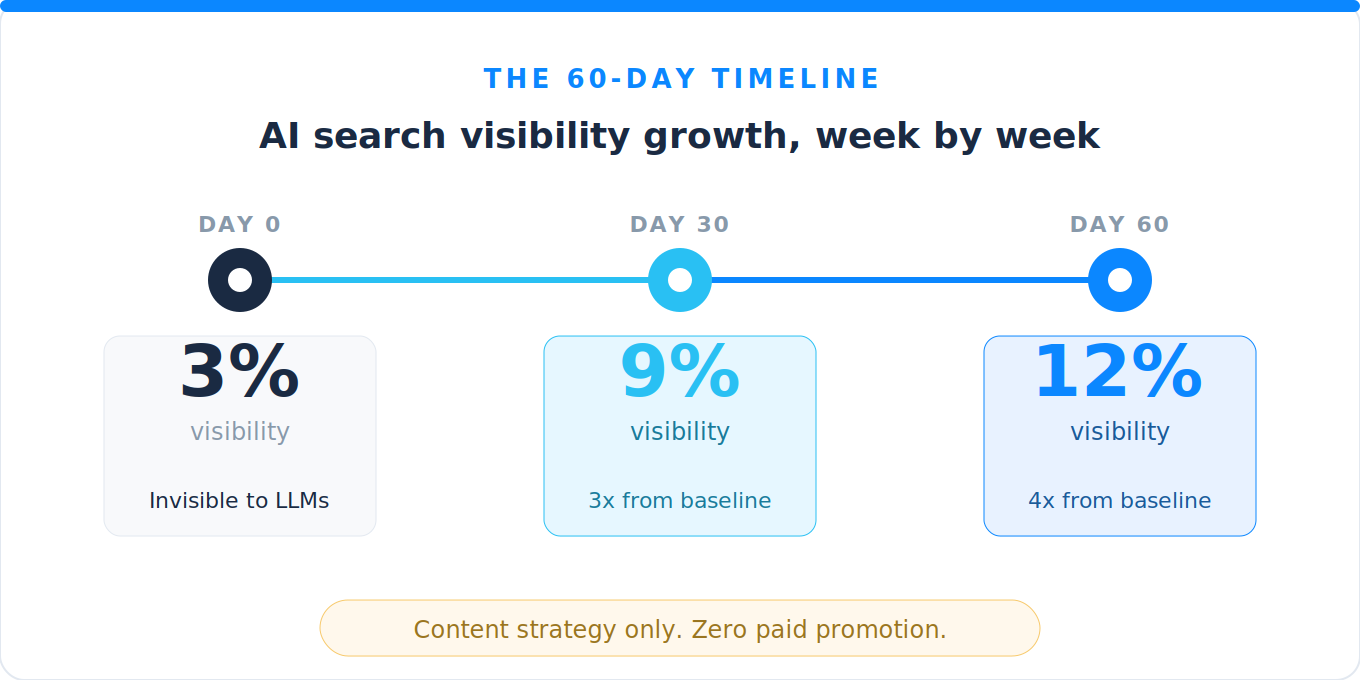
Day 0: Under 3% AI search visibility across all B2B wholesale queries. Shopify dominated. Tim's company was nearly invisible.
Day 30: After publishing six blog posts with Q&A schema and updating the homepage with FAQ content, visibility jumped to around 9%. That's a 3x increase in 30 days from a handful of content updates.
Day 60: With continued pillar page publishing and schema implementation across all existing content, visibility hit 12%. A 4x increase from baseline.
No paid ads, link building campaigns or PR pushes. This was content strategy and GEO optimization, executed consistently.
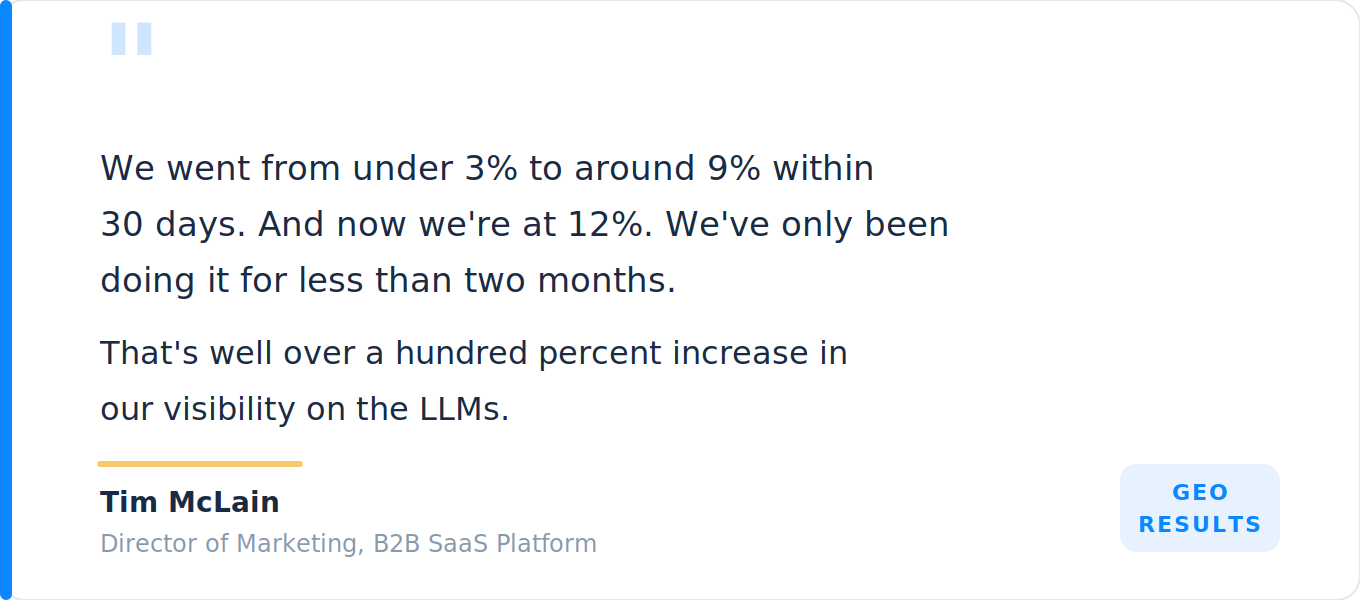
Tim put it this way: "Well over a hundred percent increase in our visibility on the LLMs. It's still a small sample, but it shows that the strategy is giving us the information the board wants to know."
The board question he couldn't answer six months ago now has a clear, data-backed response.
What Made This Work: The Five Principles
Looking at this from the agency side, five things stood out about why this strategy produced results so fast.
1. They started with prompt data, not keyword data.
The entire content strategy was built around what people were typing into ChatGPT and Perplexity, not what they were typing into Google. This is a fundamental shift. If you're building GEO content off traditional keyword research alone, you're optimizing for the wrong inputs.
2. They created content that answered prompts directly.
No fluff. No lengthy introductions. The pillar pages were structured as direct answers to specific questions. AI models prioritize content written at a conversational reading level (seventh to eighth grade) that answers the question immediately.
3. They used schema to help LLMs understand the content.
Q&A schema acts as a signal to AI crawlers. It tells the model: "Here is a question. Here is the answer." This structured data makes it easier for LLMs to extract and cite the content.
4. They front-loaded their content.
AI crawlers are impatient. If the best content is buried at the bottom of a 3,000-word page, the LLM will bounce before it gets there. Putting key information in the top 25% of the page is a competitive advantage.
5. They maintained velocity.
Two pillar pages per week. Two blog posts per week. GEO is not a "set it and forget it" strategy. The companies producing the most relevant, prompt-aligned content at the highest cadence are the ones winning visibility.
The Bigger Picture: Why Agencies Need to Offer This Now
This case study is from a single B2B SaaS company with a marketing team running GEO in-house.
Now think about what an agency bringing this to 10, 20, or 50 clients looks like.
We've onboarded over 100 agencies onto our platform, managing more than 700 client companies. Some of those agencies are reselling GEO audits and AI visibility reports for $3,000-$4,000 per month per client. They're taking the same methodology described here and packaging it as a recurring service.
The math is simple. If you're an agency with 20 SEO clients, and you add a GEO service at $3,000/month, that's $60,000 in new monthly recurring revenue. From a service your competitors aren't offering yet.
And the window is closing.
What Your Clients Are Missing Right Now
If your agency clients are running traditional SEO programs without a GEO layer, here's what they're missing.
They have no visibility into how they appear in ChatGPT, Perplexity, or Google AI Overviews. They don't know which prompts their target customers are using. They don't know which competitors are showing up. And they don't have a content strategy optimized for AI crawlers.
The companies that adopt GEO early and build a systematic content strategy around prompt data are seeing results within 30-60 days. Not six months. Not a year. Weeks.
This is a competitive advantage with a short shelf life.
As more companies catch on, the bar rises. Moving now means fewer competitors in the AI search results and faster wins for your clients.
FAQ: AI Search Visibility and GEO for Agencies
What is AI search visibility?
AI search visibility measures how often your brand, product, or content appears in AI-generated answers across platforms like ChatGPT, Perplexity, and Google AI Overviews. It's the percentage of relevant queries where your company gets mentioned or cited. Traditional SEO tools don't track this. You need GEO-specific tools to measure it.
How long does it take to see results from GEO?
Based on what we're seeing across 100+ agencies and 700+ companies on our platform, companies that publish prompt-optimized content consistently start seeing measurable visibility improvements within 30 days. The case study in this post showed a 3x increase in 30 days and a 4x increase in 60 days. Results vary based on the competitive density of your industry and the volume of content published.
Do I still need SEO if I'm doing GEO?
Yes. GEO builds on top of SEO. It does not replace it. LLMs like ChatGPT and Perplexity often start their research process by searching Google and Bing. If your site ranks well in traditional search, you're more likely to be picked up by AI models. Strong SEO is the foundation. GEO is the layer on top that ensures you're visible across AI platforms too.
What content formats work best for AI search?
Three formats perform well based on current data. Pillar pages with table of contents, structured questions, and direct answers. Blog posts with Q&A schema at the end (or embedded throughout). And FAQ pages with explicit question-answer formatting. The common thread: clear questions followed by direct, well-structured answers. AI models prefer content written at a conversational reading level with no unnecessary complexity.
How do I track AI search performance for my clients?
You need a GEO platform that monitors AI search results across ChatGPT, Perplexity, and Google AI Overviews. The platform should show you which prompts your clients are appearing for, which competitors are showing up, and how visibility changes over time. This is the data that drives content strategy and proves ROI to your clients.
What's the difference between GEO and traditional SEO?
SEO optimizes for Google's ranking algorithm using keywords, backlinks, and technical site structure. GEO optimizes for how AI models process, evaluate, and cite your content. The key differences: GEO focuses on prompt-level data instead of keyword data, structured Q&A content instead of keyword-dense pages, and AI readability instead of keyword density. Both are necessary. Neither replaces the other.
How are agencies monetizing GEO?
Agencies on our platform are adding GEO as a standalone service or bundling it with existing SEO packages. The most common pricing we see is $2,000-$4,000/month per client for ongoing GEO monitoring, content strategy, and optimization. Some agencies sell one-time GEO audit reports for significant fees. The service includes AI visibility tracking, prompt research, content recommendations, and monthly reporting.




.avif)