How to Measure GEO Campaign Success | 2026 Framework
How to Measure the Success of Generative Engine Optimization Campaigns
TL;DR / Summary
Measuring GEO success requires a different playbook than traditional SEO. You won't get search volume data, impression counts, or ranked positions from AI platforms. What you will get is a clearer picture of conversion quality, brand visibility, and revenue attribution if you set up the right systems. This guide walks you through the full measurement framework:
- Set up custom LLM channels and segments in GA4 to track AI referral traffic from ChatGPT, Perplexity, Gemini, and others
- Build a full-funnel measurement system from bot crawl activity through to revenue attribution
- Use self-reported attribution and CRM labeling to capture the AI-influenced conversions your analytics will miss
- Monitor brand visibility, sentiment, citation ownership, and share of voice across AI platforms
- Replace outdated top-of-funnel metrics with conversion-focused KPIs designed for the zero-click era
Why Your Current SEO Metrics Are Blind to AI Search
If your measurement stack is still built around Google Analytics pageviews, organic keyword rankings, and traditional conversion funnels, you're working with a growing blind spot.
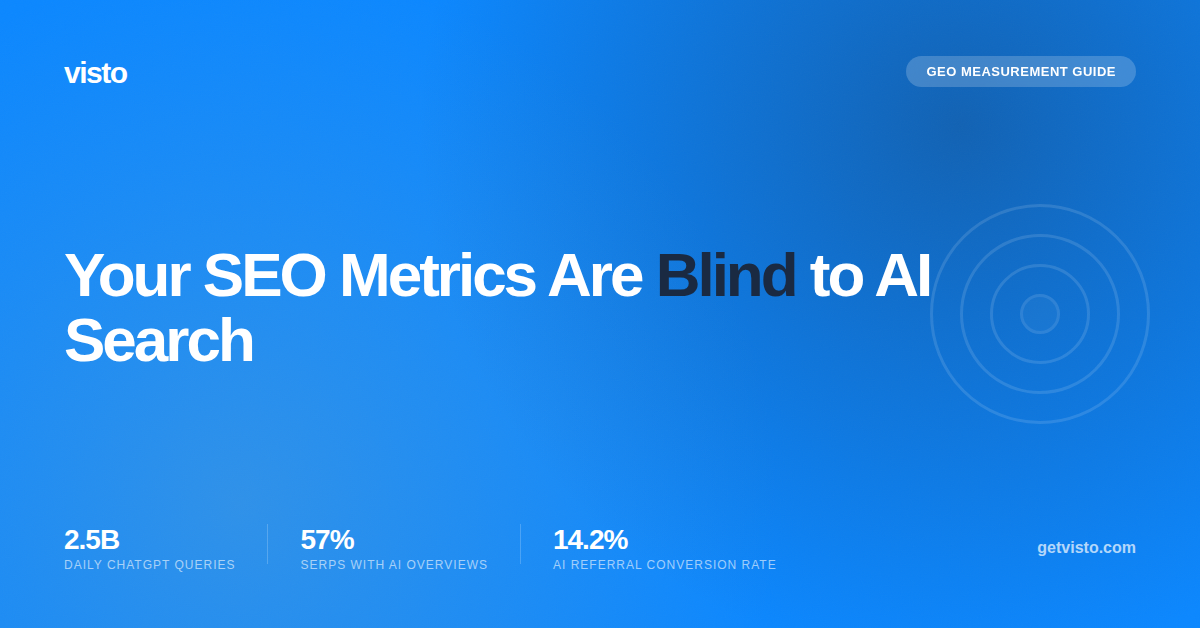
ChatGPT processes over 2.5 billion queries daily. Google AI Overviews now appear on 57% of search results pages. Perplexity recorded 153 million website visits in May 2025 alone, up 191% from a year earlier.
Your customers are asking these platforms questions about your product category, your competitors, and your brand. And your current tools have no idea what those platforms are saying about you.
This is the measurement gap every agency owner is running into right now.
The traffic-to-conversion disconnect
Conductor's data from enterprise brands shows organic traffic declines of up to 70% in certain verticals since Google rolled out AI Overviews.
For head keywords where AI Overviews sit at the top, the drop is between 30% and 70%. Those aren't long-tail terms. Those are the high-volume keywords your entire SEO strategy was built around.
But what makes this complicated for measurement is AI referral traffic converts at a higher rate than traditional organic search.
Some studies show AI-referred visitors converting at 14.2% compared to Google's 2.8%. We're hearing from agencies on our platform seeing similar patterns. Traffic drops by 70%, but conversion goes up by multiples.
Why? Because by the time someone clicks through from an AI citation, they've already been educated.
They've already had their questions answered. They arrive on your site with higher intent and a clearer idea of what they want to do. The entire top-of-funnel education step happened inside the AI platform before they ever touched your site.
If you're only measuring top-of-funnel traffic as your success metric, you're seeing a deeply incomplete picture of what AI search is doing for (or against) your business.
We’ve written a more thorough blog on how GEO differs from traditional SEO here.
The zero-click reality
40% of AI-powered searches result in zero clicks.
The user gets their answer inside the AI response and never visits a website. For informational queries, that number is even higher. Zero-click searches now make up close to 60% of all Google searches in the US and EU.
This means the traditional SEO measurement chain (impressions > clicks > sessions > conversions) breaks down at step one.
Your brand might be getting mentioned and recommended in hundreds of AI responses every week, but Google Analytics will never show you those interactions.
Your Search Console won't flag them. Your SEO tool dashboard won't register them.
A brand might be the number one recommendation in Gemini, absent from ChatGPT, and mis-categorized in Perplexity, all in the same week.
Without dedicated GEO measurement, you'd never know.
Why traditional attribution models break in GEO
Here's the typical scenario playing out across industries right now: ChatGPT mentions your brand as an option for whatever your target customer is searching.
But it either doesn't include a clickable link, or the user doesn't click it. Instead, the user opens a new tab and types your URL directly, or goes to Google and searches for your brand name.
In both cases, your analytics tool records "direct traffic" or "branded organic search."
ChatGPT gets zero credit. And this is one of the biggest measurement holes in marketing right now. Analytics tools only capture the exact click the user made to reach your site, not the complex journey they took to find out about you in the first place.
This leads to a cascade of bad decisions. Teams stop investing in channels they think aren't working. They double down on channels stealing credit at the end of the journey. And GEO, the thing driving the discovery, stays invisible in the reporting.
The metrics of the past are no longer sufficient. Focusing on top-of-funnel engagement and click-based attribution gives you a lagging, incomplete view of what's happening. Companies need to care about end conversion, and the measurement systems need to reflect that shift.
What Should You Measure in a GEO Campaign?
GEO measurement falls into three buckets. Each one captures a different layer of performance. You need all three working together to get the full picture.
AI Visibility Metrics
These tell you whether AI platforms know you exist, and what they're saying when they mention you.
Mention rate is the most fundamental. How often does your brand show up when someone asks an AI platform a question relevant to your product or service? If you sell project management software and someone asks ChatGPT "what's the best PM tool for remote teams," are you in the answer?
Citation frequency goes one level deeper. When AI does mention you, is it linking back to your content as a source? Citation ownership matters because it tells you which of your pages AI considers authoritative enough to reference.
Share of voice compares your visibility to your competitors. If a competitor shows up in 60% of relevant AI responses and you appear in 15%, that gap represents lost revenue. Tracking share of voice over time shows whether your GEO efforts are closing that gap or falling behind.
Sentiment and positioning round out the picture. AI platforms don't only mention brands. They characterize them. They describe strengths, weaknesses, and use cases. Understanding how AI frames your brand helps you identify perception gaps you need to fix.
Traffic and Conversion Metrics
These connect AI visibility to business outcomes.
AI referral traffic is the most direct signal. When someone clicks a citation inside a ChatGPT or Perplexity response and lands on your site, that visit gets attributed to the AI platform in your analytics. You need to be tracking this as its own channel (more on how to set that up in the next section).
Conversion rate by source is where things get interesting. Compare how AI-referred visitors behave versus organic search visitors. We're consistently seeing AI referrals convert at higher rates because those users arrive with more context and stronger intent. If your AI traffic is small but converting at 3-5x the rate of organic, that changes the ROI calculation significantly.
Revenue attribution ties it all together. Track AI-referred visitors all the way through to purchase or lead submission. Not every platform makes this easy, but the ones that do will give you the data your leadership team needs to see.
Proxy Metrics
These capture the AI-influenced activity your analytics will miss.
Branded search volume. If more people are Googling your brand name than they were three months ago, something is driving that awareness. Cross-reference any uptick against when you started GEO, and you'll start to see the correlation.
Direct traffic. Many users who hear about you in ChatGPT will type your URL straight into their browser. If direct traffic is climbing and you haven't changed anything else, GEO is a strong candidate for the cause.
Self-reported attribution. This is the most underused and most valuable signal in GEO measurement. We'll cover how to set it up in a dedicated section below. The short version: ask every lead how they found you, and you'll be surprised how many say "I asked ChatGPT."
How to Set Up GEO Tracking in Google Analytics 4
This is the tactical foundation. If you don't have this in place, you're flying blind on the traffic and conversion side of GEO. The setup takes about 20 minutes.
Step 1 - Create a Custom Channel for AI Chatbots
GA4 doesn't have a built-in channel for AI referral traffic.
Without one, all your ChatGPT and Perplexity traffic gets lumped into "Referral" and buried alongside every other referring domain.
Here’s how to fix that in GA4:
- Go to Admin → Channel groups (under Data display)
- Click Create new channel group (or edit your existing one)
- Click Add new channel and name it “LLMs / AI Chatbots”
- Set the rule to: Session source → matches regex
- Paste this regex:
(chat\.openai\.com|openai\.com|perplexity\.ai|copilot\.microsoft\.com|gemini\.google\.com|bard\.google\.com|claude\.ai|anthropic\.com|poe\.com|you\.com|phind\.com|character\.ai|grok\.x\.com)
- Save the channel group
One step people miss: reorder your channels. Drag your new LLM channel above the Referral channel. GA4 processes channels in order. If you don't move it up, all your AI traffic gets swallowed by the Referral bucket before your LLM channel ever sees it.
Custom channel groupings in GA4 are retroactive, so your historical AI traffic should populate as soon as you save.
Check it by going to your Traffic Acquisition report and selecting your new Custom Channel Grouping from the dropdown. If you don't see the LLM channel listed, either the setup has an error or you haven't received AI traffic yet.
Or, just try Visto.
Step 2 - Build an LLM Exploration With a Custom Segment
Standard reports give you the overview. Explorations give you the depth.
Go to the Explorations tab and create a blank free-form exploration. Create a new segment using the same regex rules from your channel setup. Then add the dimensions and metrics you want to analyze.
Two visualizations worth building:
A table showing sessions and key events broken down by LLM source and landing page. This tells you which AI platform is sending you the most traffic and which pages they're landing on. The landing page data is gold. It gives you a rough proxy for what users were searching for in the AI platform before they clicked through.
A time series showing weekly growth (or decline) of LLM traffic. This is your trend line. Review it weekly to see if your GEO efforts are moving the needle.
Look at these reports every week. Which LLMs are driving the most visits? Which landing pages are getting the most AI referral traffic? Which AI platforms are producing conversions? This data should directly inform your GEO strategy. If 80% of your AI traffic comes from ChatGPT and 2% from Perplexity, you know where to focus.
Step 3 - Connect Microsoft Clarity for Behavioral Insights
GA4 tells you who's coming and from where. Microsoft Clarity tells you what they do when they arrive.
Clarity is free. It provides heat mapping and session recording. Connect it to your GA4 data, and you get behavioral insights specific to your AI referral traffic.
This matters because AI-referred visitors behave differently than organic visitors. They tend to spend more time on page, view more pages per session, and convert more often. Seeing that behavior in heat maps and session recordings gives you qualitative evidence to pair with your quantitative GA4 data.
It also helps you optimize. If AI traffic is landing on a specific page and bouncing, Clarity will show you why. If they're converting, you'll see the exact path they took.
How to Build a Full-Funnel GEO Measurement System
Most GEO guides stop at "track your AI referral traffic in GA4." That's one layer. You need four.
Wei Zheng, Chief Product Officer at Conductor, put it well at the GEO Conference in July 2025: if you're only measuring traffic from the top-of-funnel perspective, you're seeing a deeply incomplete picture of what AI is doing to your business. You need end-to-end visibility, from bot crawl activity all the way through to revenue.
Here's the four-layer system.
Layer 1 - Bot Activity and Crawl Monitoring
Before AI platforms mention you, they need to visit your site.
AI crawlers from OpenAI, Google, Anthropic, and others regularly visit websites to index content for their models. Monitoring how often these bots crawl your site, which pages they visit, and how deep they go gives you the earliest signal of whether your content is even in the running.
Check your server logs for known AI bot user agents. Tools like Cloudflare also surface this data. If AI bots aren't crawling your key pages, the downstream metrics won't matter because you're invisible before the game even starts.
This layer answers one question: does AI know my content exists?
Layer 2 - AI Search Visibility Scores
This is where you track whether your brand appears in AI-generated responses.
Run a set of 10-20 priority prompts (the questions your target buyers are asking) across ChatGPT, Perplexity, Gemini, and Google AI Overviews. Record who shows up. Record whether you show up. Record the sentiment and framing when you do.
Do this manually on a weekly basis, or use a GEO visibility platform to automate it.
The key metrics at this layer: mention rate, share of voice against competitors, citation ownership (which URLs is AI pulling from), and sentiment analysis (is AI saying good things or flagging concerns about your brand).
Track these over time. GEO gains tend to accumulate gradually, not overnight. A visibility score that moves from 8% to 15% over 90 days tells you the strategy is working even if your GA4 dashboard hasn't changed much yet.
This layer answers: does AI mention me, and what does it say?
Layer 3 - AI Referral Traffic and On-Site Behavior
This is your GA4 and Microsoft Clarity data from the previous section.
Track sessions, landing pages, time on site, pages per session, and key events broken down by AI source. Compare these behavioral metrics against organic search and direct traffic.
Pay close attention to landing pages. They tell you which prompts are driving clicks. If your pricing page is getting AI referral traffic, users are asking commercial-intent questions and AI is sending them your way. That's a strong signal.
This layer answers: are AI users visiting my site, and what do they do when they get there?
Layer 4 - Conversion Attribution and Revenue
This is where measurement gets hard. It's also where it matters most.
Track AI-referred visitors through to lead submission, demo booking, add-to-cart, or purchase. Build conversion funnels in GA4 specific to your LLM segment. Compare conversion rates between AI traffic and other channels.
Pair this with your CRM data and self-reported attribution (covered in the next section). The combination of quantitative analytics and qualitative "how did you hear about us" data gives you the most complete picture available.
This layer answers: is AI search driving revenue?
When you stack all four layers together, you get a measurement system that covers the full journey. Bot crawls feed visibility. Visibility feeds traffic. Traffic feeds conversions. Conversions feed revenue. No single layer tells the full story. All four together do.
How to Use Self-Reported Attribution and CRM Data for GEO
This is the most underrated section of this entire guide.
If you skip everything else and only implement this, you'll still be ahead of 90% of companies trying to measure GEO.
Analytics tools capture the last click. They don't capture the discovery moment. Self-reported attribution does.
Add "How Did You Hear About Us?" to Every Form
Every lead gen form on your site should include an open-ended field asking "How did you hear about us?"
Open-ended. Not a dropdown. Not a multi-select list.
Dropdowns create bias. People pick the first option. If "Google Search" is at the top, that's what they'll select even if they found you through ChatGPT first and then Googled your name. Open-ended fields let people tell you the real story.
You'll be surprised at the level of detail you get. People will write things like "I asked ChatGPT for the best project management tool and it recommended you" or "saw you mentioned in a Perplexity search about GEO platforms." That specificity is worth more than any analytics dashboard.
This takes five minutes to implement. Do it today.
Train Your Sales Team to Validate AI Attribution
Ken Marshall from RevenueZen shared a practical framework at the GEO Conference in July 2025 that stuck with us.
In their setup, the form captures the initial "how did you hear about us" response. Then at the top of every discovery call, their SDR team has one job: ask the prospect to expand on that response.
Someone writes "AI search" on the form? The SDR asks "which AI tool were you using?" and "what were you searching for when you found us?" That follow-up turns a vague data point into an actionable insight.
This doesn't require automation. It doesn't require new software. It requires a process change and 30 seconds at the start of every call.
Make it mandatory. Every prospect. Every call. No exceptions.
Build CRM Reports That Show GEO Impact
Once you're collecting self-reported attribution consistently, build a CRM report that filters by AI-related sources.
Tag any lead where the attribution mentions ChatGPT, Perplexity, AI, Gemini, or similar terms. Track these leads through your pipeline. Measure close rate, deal size, and time-to-close for AI-attributed leads versus other sources.
These reports will likely show you that GEO-influenced leads convert at a higher rate and carry stronger intent. That's the data your leadership team, your clients, or your board needs to see.
One agency on our platform told their client: "We increased your share of voice from 3% to 12%. You were not showing up in these prompts last month. Now you're showing up because of the work we're doing." That's the story CRM data helps you tell.
How to Monitor Your Brand Across AI Platforms
Tracking traffic and conversions measures the outcome. Monitoring your brand across AI platforms measures the cause.
Manual Prompt Testing (Weekly and Monthly Cadence)
You don't need a paid tool to start. You need a browser and 30 minutes a week.
Weekly: Ask ChatGPT, Perplexity, and Gemini whether they would recommend your brand for your core service in your target location. Record the answer. Record who else gets mentioned. Record whether you're cited or linked.
Example prompt: "Would you recommend [your brand] for [your service] in [your city]?"
If you're not in the answer, ask why. AI platforms will often explain what's missing. That explanation becomes your optimization roadmap.
Monthly: Run a deeper audit. Ask each AI platform to summarize your brand's online presence, including pros, cons, and overall sentiment. Compare this against last month. Look for shifts in how you're being described. Look for inaccurate information that needs correcting on your site or third-party sources.
Keep a log. A simple spreadsheet with date, platform, prompt, response summary, and whether you appeared is enough to start seeing patterns.
Using GEO Visibility Tools to Automate Monitoring
Manual testing works for getting started.
It doesn't scale once you're tracking 50+ prompts across five platforms for multiple clients.
GEO visibility platforms automate this process. They run your target prompts daily across multiple AI engines, score your visibility, track citation sources, measure sentiment, and surface competitive gaps.
The GEO tooling market has grown rapidly. Over $77 million in collective funding went into AI search visibility startups during the May-August 2025 period alone. Tools in this space include Profound, Peec AI, Scrunch, Gauge, and platforms like Visto that combine visibility tracking with optimization and execution capabilities.
When evaluating a tool, look for: multi-platform coverage (ChatGPT, Perplexity, Gemini, Google AI Overviews at minimum), share of voice tracking, citation source analysis, sentiment monitoring, and historical trend data. The ability to connect visibility data to on-site analytics is a bonus that closes the gap between "are we showing up?" and "is it driving results?"
That’s why we created Visto 2.0, specifically for marketing agencies.
Why Cross-Platform Monitoring Matters
Each AI platform pulls from different data sources, uses different retrieval methods, and updates at different rates.
Your brand might be the top recommendation in Gemini, absent from ChatGPT, and incorrectly categorized in Perplexity, all on the same day. This isn't a hypothetical. It happens regularly.
Monitoring a single platform and assuming it represents your full AI visibility is a mistake. Spread your testing across the platforms your target audience uses most. For most B2B companies, that means ChatGPT, Google AI Overviews, and Perplexity. For consumer brands, add Gemini and Copilot.
The variation across platforms also informs strategy. If you rank well on ChatGPT but poorly on Perplexity, the fix might be different for each. ChatGPT leans on Bing search results. Perplexity has its own index. Google AI Overviews pull from Google's existing index. Different engines require different optimization approaches.
One of the most popular questions we’re asked is about Reddit & Quora and how they influence you being cited.
The Metrics That No Longer Matter (And What Replaces Them)
The marketing metrics most teams have reported on for the past decade were designed for a world where Google sent clicks and you tracked those clicks through a funnel.
That world is shrinking.
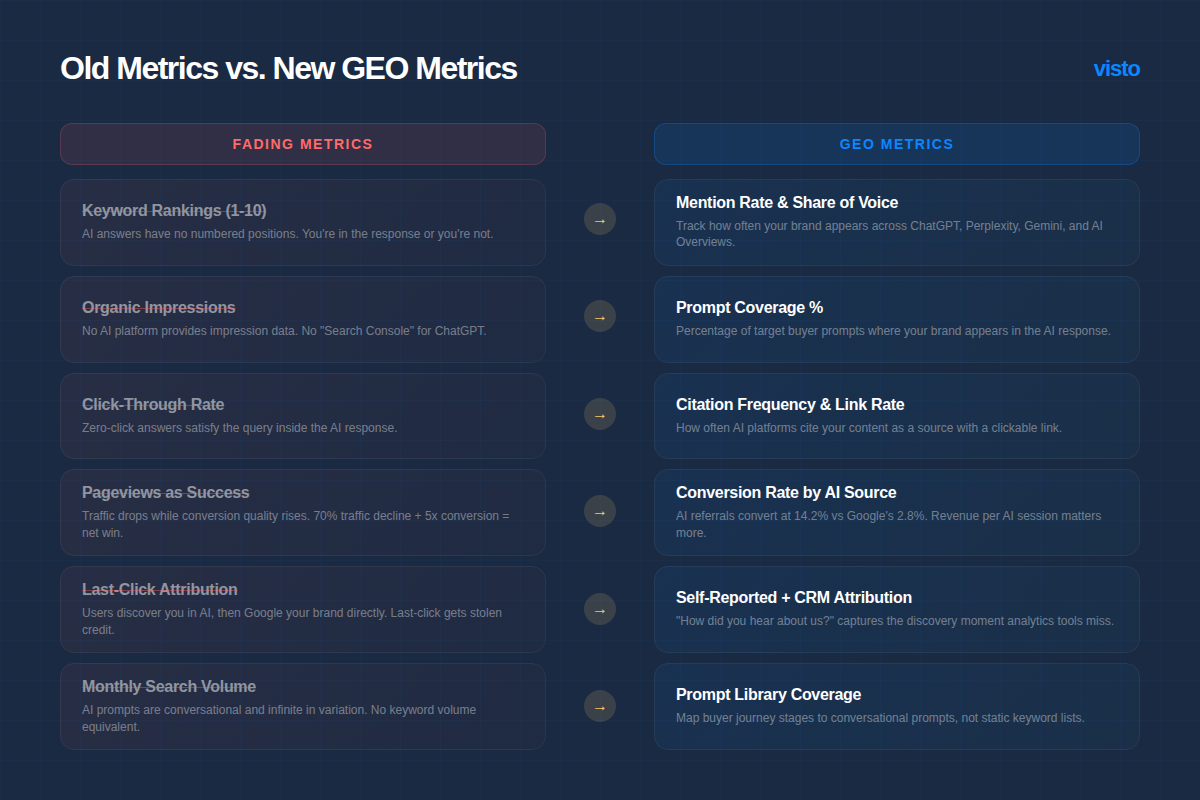
Here's how the measurement framework needs to shift:
Keyword rankings (position 1-10) → Mention rate and share of voice across AI platforms. AI answers don't have numbered positions. You're either in the response or you're not.
Organic impressions → Prompt coverage (% of target prompts where you appear). No AI platform provides impression data. There's no "Search Console" for ChatGPT.
Click-through rate from SERPs → Citation frequency and link inclusion rate. Zero-click answers satisfy the query inside the AI response. CTR declines even when visibility increases.
Pageviews as a success metric → Conversion rate by AI source and revenue per AI-referred session. Traffic volume drops while conversion quality rises. A 70% traffic decline with 5x conversion increase is a net win.
Last-click attribution → Self-reported attribution combined with CRM data. Users discover you in AI, then Google your brand or type your URL directly. Last-click gives credit to direct/branded search.
Monthly keyword search volume → Prompt library coverage mapped to buyer journey stages. AI prompts are long-tail, conversational, and infinite in variation. There's no keyword volume equivalent.
This doesn't mean traditional SEO metrics are irrelevant.
You still need strong organic rankings because AI platforms pull heavily from top-ranking content.
But your reporting dashboard needs a second layer that captures what's happening inside AI search, not just on Google's results page.
The companies adapting their measurement frameworks now are the ones who'll have 6-12 months of historical data to draw on when leadership asks "what's AI search doing for us?" next year.
The ones who wait will be starting from zero.
A Simple GEO Measurement Framework You Can Start Today
If the full system feels like a lot, start here.
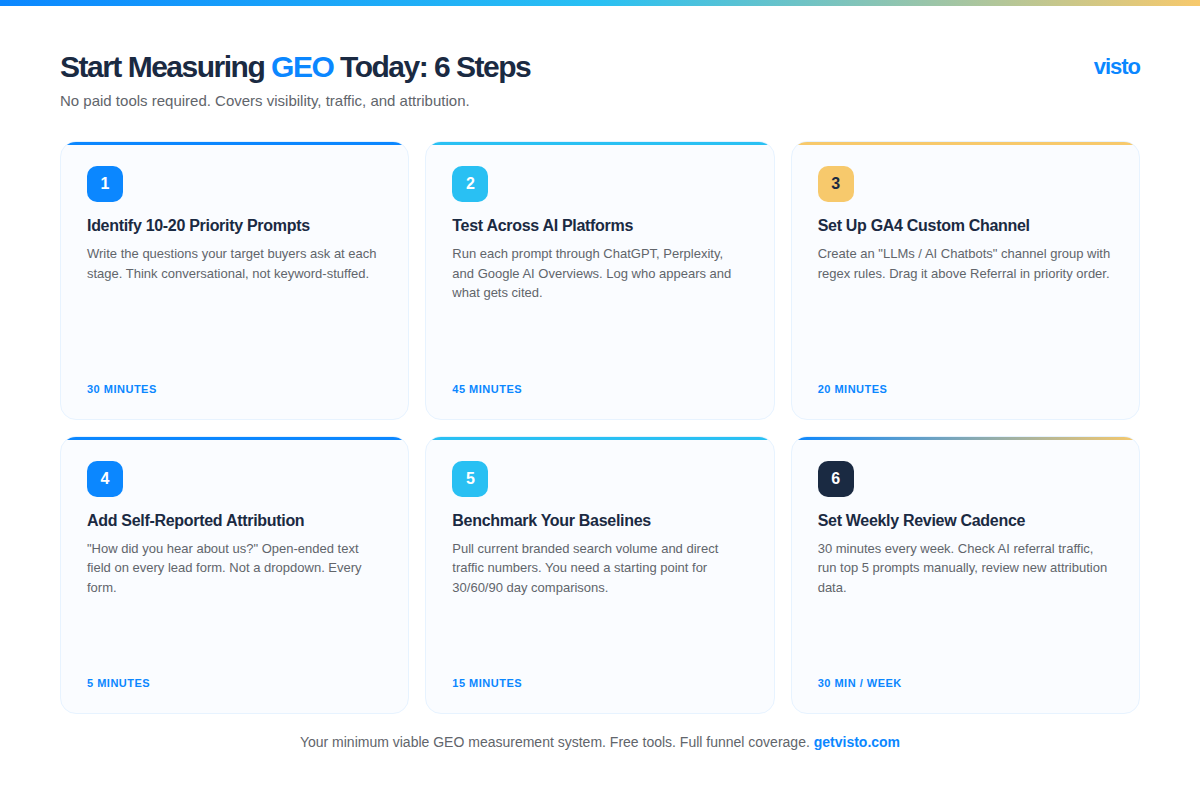
Six steps. You don't need paid tools for any of them.
Step 1: Identify 10-20 priority prompts. Write down the questions your target buyers are asking at each stage of their journey. These replace your keyword list. Think conversational, not keyword-stuffed. "What's the best CRM for small sales teams?" not "best CRM software."
Step 2: Test those prompts across AI platforms. Run each prompt through ChatGPT, Perplexity, and Google AI Overviews. Log who appears, whether you appear, what's said about you, and which URLs get cited.
Step 3: Set up your GA4 custom channel. Follow the steps from the GA4 section above. This takes 20 minutes and immediately starts capturing AI referral data retroactively.
Step 4: Add "How did you hear about us?" to your forms. Open-ended text field. Every form. Do it now.
Step 5: Benchmark your branded search volume and direct traffic. Pull your current numbers. You need a baseline before you start GEO so you have something to compare against in 30, 60, and 90 days.
Step 6: Set a weekly review cadence. Every week, spend 30 minutes checking your AI referral traffic in GA4, running your top 5 prompts manually, and reviewing any new self-reported attribution data. Log everything.
That's your minimum viable GEO measurement system.
It covers visibility, traffic, and attribution. It uses free tools. And it gives you the baseline data you need to prove (or disprove) that your GEO efforts are working.
FAQ
How long does it take to see results from a GEO campaign?
GEO optimizations tend to show results faster than traditional SEO. Most brands see measurable improvements in AI visibility within 4-8 weeks of consistent effort. Google AI Overviews may reflect changes within days. ChatGPT and Perplexity pick up new content faster than traditional search engines because of real-time search capabilities. One case study showed a brand doubling visibility in two weeks. That's aggressive, but 90-day improvement windows are common when combining on-page optimization, citation building, and content updates.
What GEO metrics should I report to leadership?
Lead with business impact. Share of voice trend over time, AI referral conversion rate versus organic, revenue attributed to AI-discovered leads (via CRM), and branded search volume growth. Avoid reporting raw mention counts without context. Leadership cares about pipeline and revenue, not how many times ChatGPT said your name.
Do I need a paid GEO tool to measure AI visibility?
Not to start. Manual prompt testing, GA4 custom channels, and self-reported attribution cover the essentials. Paid tools become valuable when you need to scale monitoring across 50+ prompts, multiple clients, or multiple platforms daily. They also provide historical trend data, competitive benchmarking, and automated alerting that manual processes struggle to match.
How do I measure GEO for multiple clients as an agency?
Use the same framework per client: custom GA4 channel, prompt library, visibility monitoring, and CRM attribution tracking. A GEO platform designed for agencies lets you manage all clients from one dashboard, compare performance across accounts, and generate client-facing reports that show share of voice gains and citation improvements. This is the data agencies need to retain clients and demonstrate ROI in the AI search era.
Why is my AI referral traffic low even though I appear in AI answers?
Because AI answers satisfy user intent without requiring a click. This is the zero-click reality. Your brand may be getting recommended in hundreds of responses, but if the AI provides enough information, users won't click through. That's why measuring traffic alone gives you an incomplete picture. Pair it with visibility scores, branded search volume, and self-reported attribution to capture the full impact.
What's the difference between GEO measurement and traditional SEO measurement?
Traditional SEO measurement revolves around rankings, impressions, clicks, and sessions. You have tools like Search Console and Ahrefs that provide clean data on all of those. GEO measurement doesn't have an equivalent data source. There's no "Search Console for ChatGPT." Instead, you combine visibility tracking (are you in the AI answer?), proxy metrics (branded search, direct traffic), traffic analytics (AI referral data in GA4), and qualitative signals (self-reported attribution, CRM data). It's messier, but the signals are there if you set up the systems to capture them.
How do I track which content gets cited by AI platforms?
During manual testing or through a GEO visibility tool, record the URLs that AI platforms cite in their responses. Over time, you'll see patterns. Certain pages get cited repeatedly. Those are your AI authority pages. Double down on keeping them updated, well-structured, and loaded with the specific, factual information AI models prefer to reference.
Will GEO measurement become more standardized?
Yes. The field is moving fast. In mid-2025, there were 6 companies building GEO tools. Within 90 days, that number jumped to 24. Over $77 million in funding went into these companies in a single quarter. As the tooling matures and platforms build better attribution systems, measurement will get cleaner. The companies collecting GEO data now will have a significant advantage when those standards emerge, because they'll have historical baselines everyone else is starting from scratch to build.




.avif)